

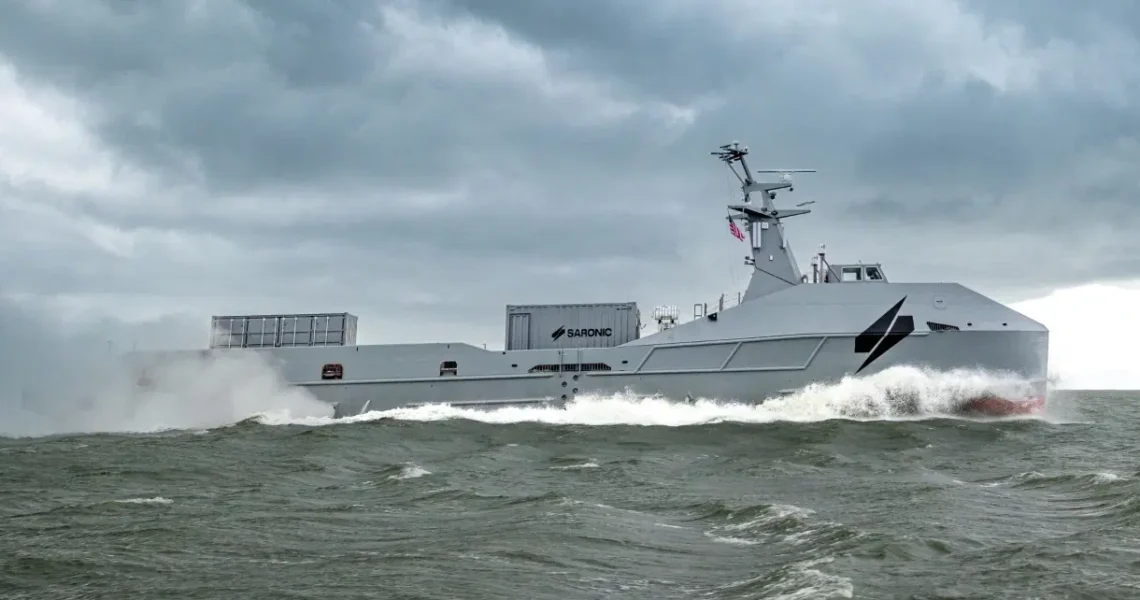
There was some big news announced last week regarding warfare that you might have missed.
BREAKING: @Saronic plans to deploy $3.2 billion to build a next-generation shipyard in Brownsville, Texas, where it will scale production of autonomous vessels. pic.twitter.com/DDZ4BlJufD
— Atoms Not Bits (@AtomsNotBits) July 16, 2026
What is Soronic and why is this a big deal? Well, I highly encourage you to head over to their website, but Soronic “provides the most advanced autonomous vessels in the maritime domain” and they are the current embodiment of the future of warfare. No big deal. Here is their original announcement:
Today, we’re proud to announce the future home of Port Alpha: Brownsville, Texas.
Our next-generation shipyard moves from vision to reality through a planned investment of more than $3 billion to establish one of the world’s most advanced shipyards, built for software-defined… pic.twitter.com/vIxkB2YUG0
— Saronic (@Saronic) July 16, 2026
For more context on why this is a big deal, John Konrad says it best:
BREAKING: The era of the autonomous dinghy fleet is over.
Until now, most autonomous naval drones have been tiny with minuscule payload, limited range, limited impact.
The Marauder changes that. It has the size to carry meaningful cargo, weapons, and fuel.
This is a major step… https://t.co/5LS2vLEqdW
— John Ʌ Konrad V (@johnkonrad) July 15, 2026
So not only are they kickstarting US ship building on the cutting edge of possible, they are doing something at scale larger than anybody else. Their flagship Marauder is roughly 180 feet in length. To see how it compares to other manned US Navy vessels, I had to ask Grok:
-
- Smaller than most manned US Navy combatants:
- Arleigh Burke-class destroyers (backbone of the US Navy surface fleet): ~505–510 feet long, ~8,300–9,700 tons full load displacement. The Marauder is roughly 1/3 the length and a tiny fraction of the displacement/tonnage.
- Littoral Combat Ships (LCS, Freedom/Independence classes): ~388–422 feet long, ~3,200–3,500 tons displacement. Still significantly larger than the Marauder.
- Larger than existing/prototype US Navy USVs:
- Sea Hunter/Seahawk (early MUSV prototypes): ~132–135 feet long, ~145 tons displacement. The Marauder is noticeably larger in length and especially in payload/volume.
- Fits in the MUSV/LUSV category:
- US Navy MUSVs are generally defined as ~39–164 feet long. The Marauder sits at the upper end (or slightly beyond in some descriptions) and exceeds typical payload/range goals for the class (e.g., Navy threshold: ~2,500 nm range with 25 MT payload).
- Large Unmanned Surface Vessels (LUSVs): Envisioned at 200–300+ feet and 1,000–2,000 tons displacement. The Marauder is smaller than full LUSV concepts but approaches the lower end in length and offers impressive payload for its size.
- Smaller than most manned US Navy combatants:
In practical terms, the Marauder is a workboat-sized autonomous platform—comparable to a large offshore supply vessel or patrol craft in scale—but with advanced autonomy, modularity, and long-range endurance. It is far smaller and lighter than destroyers or frigates (no crew, minimal structure for weapons like VLS cells in the same way), yet much more capable than smaller drone boats. Its design emphasizes high-rate production, containerized payloads for logistics/ISR/strike support, and operating as a force multiplier alongside manned ships.
-
- Sentinel-class Fast Response Cutters (FRC, WPC): ~154 feet — coastal/interdiction focus.
- Many others down to the 65-foot minimum (e.g., patrol boats, tugs, buoy tenders).
In context of the Saronic Marauder ( ~150–180 feet long, autonomous, 150 MT payload):
It is roughly the length of smaller USCG patrol cutters or the lower end of medium cutters but much smaller than the Legend-class NSC (about 40% of the length and far less displacement) or even the new OPCs. The Marauder’s uncrewed design and modularity allow significant payload/range in a compact hull, whereas USCG cutters are crewed, armed patrol ships built for sustained human operations, law enforcement, and search-and-rescue.
Here is an interesting note if you are into the politics of a deal and some potential issues that are holding back US shipbuilding.
This massive shipyard that’ll generate mountains of jobs is coming to Texas.
It was originally going to California, but the state was going to saddle it with expensive and complicated union labor requirements, environmental review, taxes, etc.
So, Saronic, welcome to Texas! https://t.co/GWZyiF2bet pic.twitter.com/lEauQ3tAuV
— Crémieux (@cremieuxrecueil) July 16, 2026
In other interesting shipbuilding news, it appears the American Bureau of Shipping has approved the design of a container ship that would run on two molten-salt nuclear reactors:
The American Bureau of Shipping has approved the design of a container ship that would run on two molten-salt nuclear reactors, placed at midship, where collision and wave loads are lowest.
With no fuel tanks and no funnel, that freed volume carries 15,000 boxes at 25 knots, on… pic.twitter.com/3vKJZW0I2w
— Winston (@ChurchillWw) July 19, 2026
This seemed like a big deal, but I don’t really have the context to understand, so I asked my brother, a former submarine nuke. He basically said, imagine not having to refuel a ship for 35 years…