

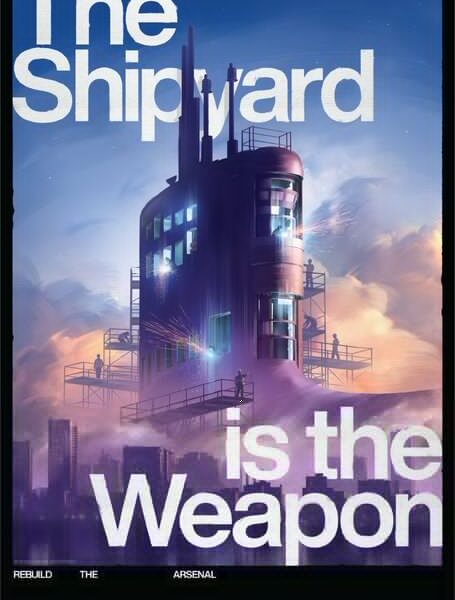
Okay, long post alert. I had no idea I had this many articles bookmarked in my history on shipping. First things first: I don’t know ship about shipping. I am not an expert in any sense of the word. Just a dude who watches social media and cares about National Security. So, with that out of the way, let’s talk shipping…
One more thing before we dive in. I have worked in National Security (played a small, supporting role of limited importance) for almost 30 years, and I have never seen anything come close to the pace of change we are witnessing today. No matter what you think about the current administration, the pace of change is incredible, and I love the open embrace of technology.
With that out of the way, let’s turn to the real expert, Sal Mercogliano. Here, he discusses the potential of outfitting commercial ships with real defensive capabilities. This, in my opinion, is a necessary step because actual shipbuilding has been neglected for so long.
So piecing together the evidence it appears that the US may have converted St Helena into a armed merchant cruiser.
The Marines looked at putting Armed Guards on board commercial ships three years ago as reported by @USNINews.
Add modular/containerized weapon systems, @US5thFleet could be converting small cargo ships, offshore support vessels and even larger commercial ships into vessels with armed guards on board to defend against drones and small boats.
They would still need air cover for more dynamic threats, specifically missile – both cruise and ballistic.
https://t.co/ZfEHEvMdkT
— Sal Mercogliano (WGOW Shipping) 🚢⚓🐪🚒🏴☠️ (@mercoglianos) September 28, 2026
Drone boats, you say. Here is a small portion:
“These systems are incredibly useful and capable,” explained Niedziocha, now director of the USMC Expeditionary Warfare School. “And you say, ‘Hey, you know, [in] the next war, if the first thing you’re putting through the breach isn’t a robot, something’s wrong. You say never send a Marine someplace you haven’t sent a bullet. I think the new way is [you] never want to send a Marine someplace you haven’t already sent a robot. So yeah, we’re embracing [the technology] and we’re not leaders. We’re fast followers in that regime.”
Marine Colonel Who Led Mideast Combat Deployment Wants His Own Drone Boats
“If the first thing you’re putting through the breach isn’t a robot, something’s wrong.”
https://t.co/kPY4ufH6Kn
— Tyler Rogoway (@Aviation_Intel) September 18, 2026
But first, the vision…
The Pentagon has announced plans for a new functional combatant command, very broadly akin to U.S. Special Operations Command (SOCOM) or U.S. Space Command (SPACECOM), but for operational activities involving autonomous and robotic capabilities. Secretary Pete Hegseth has also announced new initiatives to help further accelerate the fielding of uncrewed systems in the air, at sea, and on land, as well as to explore future warfighting challenges. All of this builds on previous and long-overdue efforts to prioritize the fielding of various tiers of drones, as well as artificial intelligence (AI) and other emerging technologies, across domains, but there are questions about how these new efforts will translate into tangible developments.
Vision For New Autonomous Warfare Command Laid Out By Pentagon
The new command, slated to stand up late next year, will focus on advancing operational autonomous and robotic capabilities across the services.
https://t.co/GJkv1hVwmk
— Tyler Rogoway (@Aviation_Intel) September 30, 2026
Drone boats.
The awards “mark a significant step forward in translating the strategic vision into a tangible fleet capability,” Chris Miller, the Navy’s Acting Direct Reporting Portfolio Manager for Robotic and Autonomous Systems (DRPM RAS), told TWZ and others at a media roundtable earlier today. “Each agreement is for the procurement of 10 MUSV at an average procurement cost of $40 million per vessel.”
Navy Orders 30 Drone Ships To Finally Advance Its ‘Medium’ Uncrewed Vessel Ambitions
The Navy has taken an important step toward to fielding larger USV fleets, an area where it has persistently struggled in the past.
https://t.co/HiQTI7olJM— TWZ (@thewarzonewire) September 29, 2026
Saronic is the leader here. The pace of design to implementation is mind-boggling. If you cannot see below the fold…
“Marauder went from initial design to on-the-water in under a year, and this evaluation demonstrated that the platform holds up under the Navy’s own toughest testing,” said Dino Mavrookas, CEO and Co-Founder. “We’ve now flipped our third Marauder hull, with several more moving through the production line behind it. We can build at that pace because we designed the autonomy, software, hardware, and the production process side-by-side, as one system, rather than bolting them together after the fact. That’s what it means to be a vertically integrated shipbuilder, and it’s why we’ve been able to build and deliver at speed and scale.”
Saronic has been awarded a production OT under the U.S. Navy’s MUSV Marketplace for Marauder, our 180-foot dual-use autonomous ship — following a rigorous at-sea evaluation that tested the vessel’s capabilities.
The trials included autonomously tracking and maneuvering around a variety of vessels, plus a battery of passive-perception tests — requiring Marauder to detect, track, and follow other vessels using only its passive onboard sensors, with no active radar. It’s one of the hardest problems in autonomous maritime systems, and Marauder ran every scenario back-to-back on the same platform now under contract with the Navy.
“Marauder went from initial design to on-the-water in under a year, and this evaluation demonstrated that the platform holds up under the Navy’s own toughest testing,” said Dino Mavrookas, CEO and Co-Founder. “We’ve now flipped our third Marauder hull, with several more moving through the production line behind it. We can build at that pace because we designed the autonomy, software, hardware, and the production process side-by-side, as one system, rather than bolting them together after the fact. That’s what it means to be a vertically integrated shipbuilder, and it’s why we’ve been able to build and deliver at speed and scale.”
— Saronic (@Saronic) September 29, 2026
It is not all about drones, though. It is about delivering at scale in new and refurbished shipyards.
As part of its overall effort to boost America’s flagging shipbuilding capacity, the Trump administration on Tuesday announced that Anduril is building a new two-million-square-foot facility in Baltimore designed to help speed up the production of Virginia class nuclear-powered attack submarines. The plant, dubbed Arsenal-2, will eventually produce components like torpedo tubes and spherical air flasks, which will then be sent to the two shipyards that build nuclear submarines, General Dynamics Electric Boat and Huntington Ingalls Industries’ Newport News Shipbuilding. Anduril’s plan to build complex submarine components is a huge leap for a company with a shipbuilding portfolio consisting of a limited number of smaller craft.
Anduril Dives Into Submarine Construction With New Baltimore Plant
The plans for the new facility to build submarine components were announced as the Navy is struggling to meet its delivery goals.
https://t.co/bhEZLlD03U
— Tyler Rogoway (@Aviation_Intel) October 6, 2026
The scale.
Anduril is building America’s largest shipyard since WWII. This space needs bold investment and decisive action.
In the 1790s, Baltimoore clippers were the fastest and most advanced sailing ships of their time. King George III didn’t stand a chance. Time to run the same play.
— Palmer Luckey (@PalmerLuckey) October 6, 2026
The model.
Arsenal-2 will take time to build, but there’s no time to wait.
While construction of Arsenal-2 moves forward, we’re already producing Virginia-class test assets and critical maritime components in a 160,000-square-foot Proto-factory right here in Orange County, California. https://t.co/F9zzyOs6zK
— Anduril Industries (@anduriltech) October 8, 2026
The cash
When people ask me why the U.S. hasn’t solved its shipbuilding problem, I’ve always given the same answer: Because it’s going to cost a giant pile of money to make any appreciable progress.
Well, Anduril’s got a big pile of money, and this seems like a good use for it.
— Alex Hollings (@AlexHollings52) October 7, 2026
The know-how.
“The United States has rebuilt its industrial strength before. We must do so again. Arsenal-2 is Anduril’s commitment to that future — and to America’s ability to refit the fleet for the century ahead.”
– Brian Schimpf, Co-Founder and CEO of Anduril https://t.co/l2zgBDKjvG
— Anduril Industries (@anduriltech) October 6, 2026
The partners.
We’re partnering with @anduriltech and deploying our AI and robotics for the new Arsenal-2 shipyard to accelerate submarine production.
Gecko’s technology has already reduced inspection timelines for forged components in the manufacturing process by up to 90%.
This partnership is a direct response to America’s maritime production challenge, helping rebuild the industrial capacity required to deliver the next generation of submarines, ships, and autonomous maritime systems.
— Gecko Robotics (@geckorobotics) October 8, 2026
Naval automation is limited to drone boats. How about a vertical take-off fighter drone?
Shield AI says it is on track to roll out the first prototypes of its X-BAT jet-powered stealth ‘fighter’ drone by the end of this month. Flight testing of this uncrewed aircraft, which is designed to take off and land vertically from a tail-sitting position, is still scheduled to kick off before the end of the year. X-BAT’s core concept was already highly ambitious, but an extremely aggressive timeline to reach some degree of operational capability through the U.S. Navy’s Runway Independent Maritime Expeditionary Strike (RIMES) program has now been disclosed.
Navy Doubles Down On X-BAT VTOL ‘Fighter’ Drone Development
X-BAT flight testing is getting closer on the horizon, and an extremely ambitious timeline to reach an operational capability has been revealed.
https://t.co/RZ20oUQLRv
— Tyler Rogoway (@Aviation_Intel) October 8, 2026
The @USNavy and Shield AI have committed $400 million to advance X-BAT toward flight testing.
The Navy’s latest $150 million modification supports Defense Exportability Features, building exportability and technology protection into X-BAT early in its development. Shield AI is matching that amount.
Along with a separate $50 million Navy and @DIU_x action announced in August, the two funding actions total $200 million in government support and $200 million in Shield AI investment.
Shield AI and key suppliers now have 500 engineers building the flight-test aircraft. Flight testing begins this year.
Autonomy for the world. The greatest victory requires no war.
— Shield AI (@shieldaitech) October 8, 2026
The Navy is great and all but what about a strategic commercial fleet? Outsourcing shipbuilding was a strategic failure, and they are finally starting to truly address it.
The Case for a Strategic Commercial Fleet
When it comes to fueling and sustaining what will be a national generational endeavor to revive America’s maritime industry, there needs to be demand for ships. Globally the demand for new commercial ships of various classes is growing and growing rapidly as today’s fleet average over 20 years old – over the typical service life of such ships.
See the foundational report here: https://t.co/uAhehTxck0
So giving confidence that orders for ships will be sustained at revived American shipyards needs an order book. On top of macro global shipbuilding trends, the need to ensure greater national security and supply chain resilience is critical – earlier research points to the need for 1315 assured shipping of several classes required.
A more manageable demand is included in draft SHIPS for America Act legislation – a 250 ship fleet of commercial ships important to sustaining America’s economy. It also represents a decade long order plan of ships to kickstart the industrial revival at American shipyards.
The business case is that as orders filled, workforce training and shipyard capital investments will improve American shipbuilding productivity, driving costs down in time. Reviving this industry will not be smooth given decades of underinvestment etc.
@HudsonInstitute @Heritage @SenTedCruz @SenatorCantwell @RepTrentKelly @SpeakerJohnson @michaelgwaltz
See the video explain this more by a shipmate of mine on this effort:
— Brent D. Sadler (@brentdsadler) October 8, 2026
Nuclear power on ships.
EXCLUSIVE VIDEO INTERVIEW: America’s most critical West Coast port is becoming a proving ground for floating nuclear power.
Barges already move grain, oil, steel and some of the heaviest equipment in the economy. Now Bluecore Energy, fresh off a $50M seed round, wants to put light water reactors on them, starting at the Port of Long Beach.
Atoms Not Bits went inside @BluecoreCo with founder and CEO Kofi Asante to understand how maritime nuclear could end up delivering everything from clean water to Wi-Fi.
— Atoms Not Bits (@AtomsNotBits) September 18, 2026
To wrap this up, well, you should actually just follow Tyler Rogoway and TWZ (The War Zone); outside of that, you are finally seeing a real commitment to shipbuilding and the changing nature of warfare. Like it or not, drones are the future, and it is about time that we are investing in that future at scale. Follow the links, read about it, know it. What an incredible time to be alive.
The new era of American seapower starts with Arsenal-2: the biggest investment in a new American shipyard since World War II. https://t.co/EtIcqnYkas
— Anduril Industries (@anduriltech) October 6, 2026