

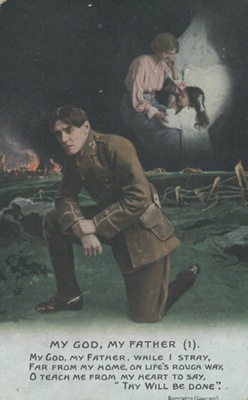
This is the second, in a hopefully continuing series about faith on this platform. In many ways, putting it down on paper helps me articulate it, helps me develop not necessarily what I believe but more how to believe. These posts could be considered a working draft of my testimony, but isn’t that true for all of us? We are all a work in progress… until, we are not. It is never too late to take that first step on your own journey. As I have been trying to work out the intent for this series of posts, I reached out to several people that I deeply respect and was asked the question, how does faith impact cognitive decision making in combat? I am not sure I can answer that question fully just yet other than some rather scripted ‘it provides the undergirding of moral decision making when faced with dilemma’ …not exactly what I would like to convey in this space, but I can tell you a story.
When I got back from my first deployment, I was holding court so to speak by telling some of our war stories about some instances we got ourselves in ‘a tight spot.’ To be honest, I had been drinking and was sort of enjoying the moment. I was home, my deployment went relatively well, and I was able to tell my story. It was in this moment that my sister-in-law asked me a question that I have thought about a lot now for over 20 years. “Did I pray when I was in those situations?” The honest answer was probably a bit more complicated than what I said but, the answer was no. I did not pray because I felt guilty asking God for help when I was in a tight spot but didn’t go to him when times were good. It felt hypocritical to me. There may have been a touch more bravado in the response but that honesty profoundly disappointed me. I wish I could say that that level of honesty immediately impacted how I lived but it did not. It would take me years before I would attempt to commit more fully to an actual relationship with God, a relationship where we talk in the good times and the bad, and I am still working on it. So, what is the point of this story? Well, I guess it is because I believe that warfighters should have cognitive clarity that enables bold decisiveness. Where one errors to side of action as opposed to inaction bound by indecision. Looking back, I wasn’t ready. There was a built-in hesitancy that I should have confronted earlier. Fortunately, it’s never too late to start.
For more on my faith journey and the reasons I generally didn’t write about faith you can go here. But as a reminder, the framework for this post is the discussion guide provided by our church about this Sunday’s service. You can watch the entire service at the end of the article below.
This Saturday, I was scrolling through headlines and come across this story on Zerohedge, From Vision To Reality: McDonald’s, Regenerative Agriculture, & A Cultural Shift. It is not everyday that I talk about a story originally printed in the Epoch Times, but this was really good and is something I believe in. I wanted to have a standalone article about regenerative agriculture, but I think it actually fits better here. This article sent me down the documentary rabbit hole where I watched both.
And
I highly recommend both although I think the second was a bit unnecessarily political and if you had to choose one, it should be Kiss the Ground. For those of you that do not know, I was an environmental studies major when I was in college and there is a little activist still alive in me. That and I am a sucker for a good eviro-documentary!
What is Regenerative Farming?
Regenerative farming is a process that goes beyond conservation and sustainability, to actually leave land better than we found it. Not only is regenerative farming a beneficial practice overall, but it can also be used to rehabilitate overprocessed land that has previously been used for monocropping [monoculture] or intensive grazing.
The core principles of regenerative agriculture focus on working with nature to rebuild soil health, enhance biodiversity, and improve the water cycle through practices that minimize soil disturbance, keep living roots in the soil, maintain diverse crops and livestock integration, and protect the soil surface with cover crops or mulch.
I highly recommend watching both. However, this article is not about farming, but it is about the ‘soil’ that we are planted in, for if we are to be planted in the Word, our soil needs to be healthy. I thought that it was interesting that crops gown in a mono-culture (or modern culture) degrades the soil and can leave you barren and susceptible to erosion. Can that physical erosion be a metaphor for our faith? Now that we have a little background on my mindset going into this weekends service, let’s jump in.
(Editor’s Note: When you see ‘Note’ below, these are not entirely my words but are largely derived from my Live Application Study Bible’s note section. I cannot take credit for them and am not that smart.)
Psalm 1:1-4 (NLT)
1 Oh, the joys of those who do not
follow the advice of the wicked,
or stand around with sinners,
or join in with mockers.
2 But they delight in the law of the Lord,
meditating on it day and night.
3 They are like trees planted along the riverbank,
bearing fruit each season.
Their leaves never wither,
and they prosper in all they do.
Note: Our friends and associates can have a profound influence on us, often in subtle ways…Do your friends build up your faith or tear it down? True friends should help you draw closer to God, not hinder your relationship with him.
1. The message reminded us that everything in our lives grows out of what we are rooted in. When you think about your own life, what voices, influences, or sources are you most rooted in day-to-day? How does the Bible compare in shaping your worldview?
What is the Word?
John 1:1-14 (NLT)
1 In the beginning the Word already existed.
The Word was with God,
and the Word was God.
2 He existed in the beginning with God.
3 God created everything through him,
and nothing was created except through him.
4 The Word gave life to everything that was created,[a]
and his life brought light to everyone.
5 The light shines in the darkness,
and the darkness can never extinguish it.[b]
6 God sent a man, John the Baptist,[c] 7 to tell about the light so that everyone might believe because of his testimony. 8 John himself was not the light; he was simply a witness to tell about the light. 9 The one who is the true light, who gives light to everyone, was coming into the world.
10 He came into the very world he created, but the world didn’t recognize him. 11 He came to his own people, and even they rejected him. 12 But to all who believed him and accepted him, he gave the right to become children of God. 13 They are reborn—not with a physical birth resulting from human passion or plan, but a birth that comes from God.
14 So the Word became human[d] and made his home among us. He was full of unfailing love and faithfulness.[e] And we have seen his glory, the glory of the Father’s one and only Son.
Note: Jesus is fully human and fully God. Although Jesus took upon himself full humanity and lived as a man, he never ceased to be God. The Word was a term used by theologians and philosophers. In Hebrew scripture, the Word was an agent of creation, the source of God’s message to the people through the prophets and God’s law. In Greek, the Word was the principle of reason that governed the world. In Hebrew, the Word was another expression for God.
2 Timothy 3:16-17 (NLT)
16 All Scripture is inspired by God and is useful to teach us what is true and to make us realize what is wrong in our lives. It corrects us when we are wrong and teaches us to do what is right. 17 God uses it to prepare and equip his people to do every good work.
Note: Scripture is God breathed and inspired Word. Because it is inspired and trustworthy, we should read it and apply it.
2 Peter 1:20-21 (NLT)
20 Above all, you must realize that no prophecy in Scripture ever came from the prophet’s own understanding,[a] 21 or from human initiative. No, those prophets were moved by the Holy Spirit, and they spoke from God.
2. The Bible is inspired by God but communicated through human authors. How does that truth impact the way you approach Scripture—both its authority and its accessibility?
The Bible is historically verified, Internally consistent and faithfully preserved.
Romans 15:4 (NLT)
4 Such things were written in the Scriptures long ago to teach us. And the Scriptures give us hope and encouragement as we wait patiently for God’s promises to be fulfilled.
Note: The knowledge of the Scriptures affects our attitude toward the present and future. The more we know about what God has done in years past, the greater confidence we have about what he will do in the days ahead. We need to diligently read our Bibles so we may have confidence the God’s will is best for us.
3. The Bible is not just a religious text but a trustworthy, powerful Word of God that brings stability and clarity in a world of change. Can you share an example of a time when God’s Word brought clarity, encouragement, or correction to you?
Can I trust the Bible?
Hebrews 4:12 (NLT)
12 For the word of God is alive and powerful. It is sharper than the sharpest two-edged sword, cutting between soul and spirit, between joint and marrow. It exposes our innermost thoughts and desires.
4. John 20:31 says Scripture was written “so that you may continue to believe that Jesus is the Messiah… and have life by the power of his name.” How does this purpose challenge or encourage the way you engage with the Bible?
John 21:24-25 (NLT)
24 This disciple is the one who testifies to these events and has recorded them here. And we know that his account of these things is accurate.
25 Jesus also did many other things. If they were all written down, I suppose the whole world could not contain the books that would be written.
So to summarize a very long post into one sentence, stay planted word to develop healthy soil so that you can grow spiritually! Here is a link where you can watch the entire service!